Sea-Can Covers and Container Shops: Affordable Covered Storage in the Peace Region
What Is a Sea-Can Cover?
A sea-can cover is a roof built between two shipping containers. The containers act as the side walls, and an engineered roof spans the gap between them. You end up with a covered bay in the middle and two lockable storage units on either side.
Around Dawson Creek, Fort St. John and the rest of the Peace Region, they're a popular way to get equipment, trailers, hay and vehicles out of the snow without building a full shop. If you already own containers, or can pick them up locally, a cover can be one of the most cost-effective ways to add covered space to an acreage, farm or yard.
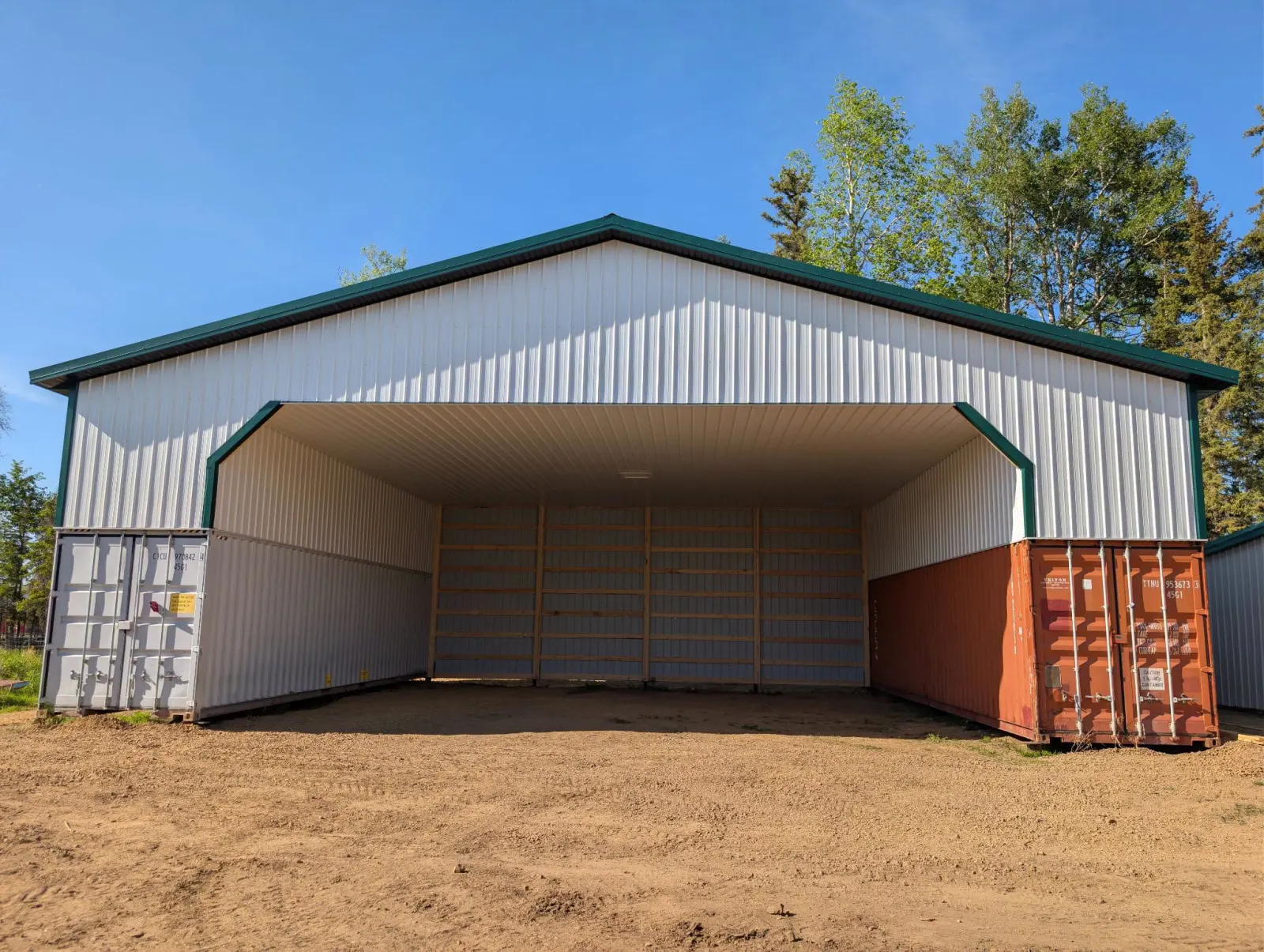
The photo above is one we built this season: two 40-foot containers with a white steel roof, green trim and a tall open front. The back wall is framed and clad, so the bay is sheltered from wind and drifting snow on three sides.
How Container Covers Work
Every sea-can cover comes down to three parts working together:
- The containers: They carry the roof load down to the ground and give you secure storage. They need to be set level and square to each other, with the same height on both sides.
- The roof structure: Engineered wood trusses or a steel frame span between the containers. The trusses sit on a top plate or bracket fastened to the container's top rail, so the load goes into the strongest part of the box.
- The connections: This is where cheap kits and DIY builds usually fall short. The roof has to be tied down against wind uplift and fastened so it can't slide or rack. Every connection should be designed, not guessed.
Gable-end walls are optional. An open front is the simplest and gives you the widest door. A framed back wall, like the one above, blocks prevailing wind and keeps snow from blowing through.
Sizing: 20-Foot vs 40-Foot Containers
Two numbers set the size of your cover: the container length and the span between them.
- Container length sets the depth. Standard containers come in 20-foot and 40-foot lengths. Forty-footers give you a deep bay for long trailers, combines, boats or two vehicles nose to tail. Twenty-footers suit a smaller yard or a single vehicle bay.
- The span sets the width. This is the clear distance between the two containers, and it's the number that drives truss design and cost. Wider spans mean bigger trusses and more material.
- Height matters. Standard containers are about 8.5 feet tall and high-cube containers about 9.5 feet. The roof pitch adds clearance in the middle, but the eave height is set by the containers. If you need to drive a tall tractor or a loaded truck in, plan the height before you buy the containers.
Measure what you actually need to store, add room to walk around it and open doors, and work back from there. Our shop size guide is a good reference for how much space common vehicles and equipment take up.
Snow Load and Wind: The Part You Can't Skip
A roof between two containers carries the same snow as any other roof. In the Peace Region that's a lot. Ground snow loads vary by community, and some areas like Chetwynd and Tumbler Ridge run noticeably higher than Dawson Creek or Fort St. John. Our frost depth and snow loads guide lists typical values by town.
Wind is the other half. An open-front cover acts a bit like a sail: wind blows in under the roof and tries to lift it off. That's why the roof needs proper hold-down connections to the containers, and why the containers themselves need to stay put.
Cheap fabric covers and generic kits are often rated for milder climates. If the snow load rating isn't stated for your location, or the kit has no engineering behind it, treat that as a warning sign.
Foundations and Anchoring
Containers are strong, but only if they sit level and stay level. If one corner settles or heaves, the roof racks, doors stop closing and connections start to work loose. A good base is the cheapest insurance you can buy.
- Compacted gravel pad: The most common option. A well-drained, compacted pad with the containers set on blocking or pads at the corners. Drainage is the key: wet ground freezes deeper and heaves harder.
- Screw piles: For soft or wet ground, or where you can't tolerate movement, screw piles under the container corners put the load on stable soil below the frost line. They can go in year-round, including frozen ground. If you're wondering how many you'd need, see how many screw piles do I need.
- Site prep first: Clearing, stripping topsoil and building the pad properly makes everything after it easier. Our site preparation guide covers what's involved.
Permits and Zoning
Many people assume a roof over two containers doesn't need a permit. Sometimes that's true, often it isn't. Most jurisdictions treat a roofed container structure as an accessory building, and size, setbacks and zoning all come into play. Rules differ between the City of Dawson Creek, the City of Fort St. John and the Peace River Regional District.
Check before you buy containers or trusses. Our guide to construction permits in Fort St. John walks through the process and what the building department usually asks for. If you work with us, we'll help sort out what's required for your property.
Open Cover vs Container Shop
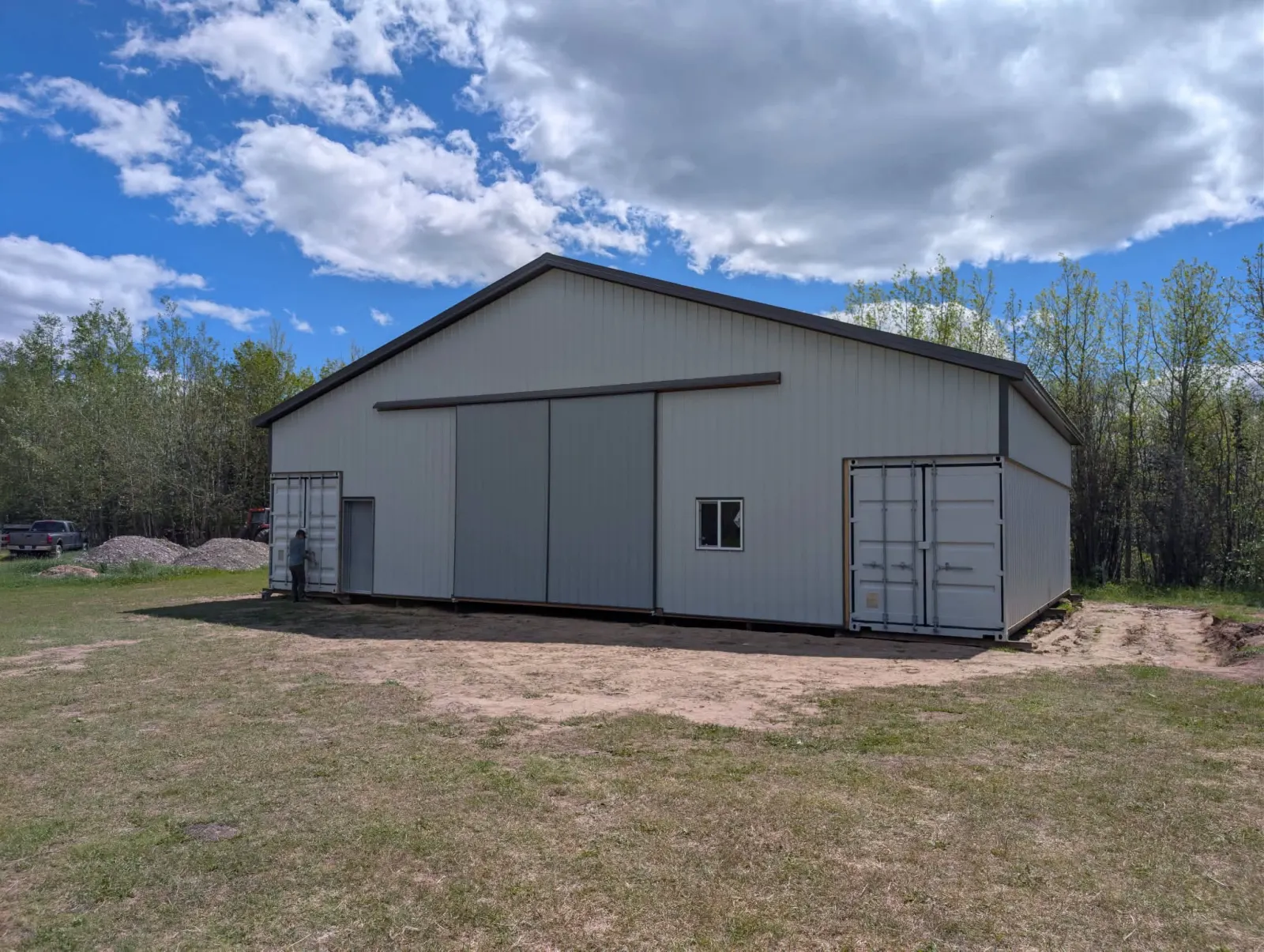
An open cover is just one option. You can also build a fully enclosed building that uses containers as part of the structure, like the one above. Here, containers are built into each end of a clad building, with a wide sliding door in the middle and a man door and window for everyday access. From the outside it reads as one clean building, while the containers give lockable storage at each end.
This approach makes sense when you want the building closed in against wind and snow but don't need heat. It's a good middle ground for farm equipment, seasonal storage and vehicles.
When a Full Post-Frame Shop Is the Better Choice
Sea-can covers are great value for cold storage. They're not the right answer for everything. A purpose-built post-frame building is usually the better choice when:
- You want heat: Insulating and sealing around steel containers is awkward. A post-frame shop is designed to be insulated from the start, with spray foam or blown-in insulation.
- You need a concrete floor: A slab, floor drains and in-floor heat are much easier to plan into a shop than retrofit under a container cover.
- You need wider spans or taller doors: A post-frame building isn't limited by container height, so tall overhead doors for big equipment are straightforward.
- You don't already own containers: Once you're buying containers and a roof, the cost gap to a proper shop can be smaller than you'd think. Get both priced.
If you're weighing building methods, our post-frame vs stick-frame guide explains the trade-offs. Plenty of our customers start with a cover and add a heated shop a few years later.
Frequently Asked Questions
Can I put a roof between two sea-cans?
Yes. A sea-can cover uses two shipping containers as the side walls and spans engineered trusses or a steel frame between them. The roof has to be designed for local snow and wind loads, and the trusses have to be fastened to the containers properly, so it should be engineered rather than improvised.
Do I need a building permit for a sea-can cover?
Often, yes. Rules depend on your municipality or regional district, the size of the cover and how the property is zoned. Many jurisdictions treat a roofed container structure as an accessory building. Check with your local building department before you buy materials.
Should I use 20-foot or 40-foot containers?
Use 40-foot containers if you want a deep cover for long equipment, trailers or several vehicles. Use 20-foot containers for a smaller footprint, a single vehicle bay or a tight yard. The container length sets the depth of the covered area, and the gap between them sets the width.
Can a sea-can cover be enclosed and heated later?
It can be enclosed with end walls and doors, and some owners do insulate them. But if you know you want a heated, finished shop, a purpose-built post-frame building is usually the better long-term choice. It is easier to insulate, seal and wire than a structure built around steel boxes.
What foundation does a sea-can cover need?
Containers need a level, well-drained base. That is usually a compacted gravel pad, with blocking or pads at the container corners. For sites with poor soil or where movement must be minimized, screw piles under the corners give a solid footing below the frost line.